After a rest day in Jimbaran to recover from the journey and jet lag, our family trip to Bali can finally begin. We set off to discover the gems of the Island of the Gods, starting with two Bali’s iconic Hindu temples: the Uluwatu and the Pura Ulun Danu Bratan.
Thursday, February 5, 2026
After a hearty breakfast at the hotel restaurant, it’s time to check out. The day before, in Kuta, we had booked a driver for the day. He’s taking us all the way to Lovina Beach, in the north of Bali. There are 5 of us, with just as many bags, so he shows up with a large 9-seater minivan! Needless to say, we are travelling in style. Maybe a little too much so… The driver quickly decides the minivan is oversized for our group. He wants to switch to a smaller vehicle that’s easier to handle in Bali’s chaotic traffic. In the meantime, we set off in the minivan toward the Bukit Peninsula, in the south of the island, where we’ll visit one of Bali’s most famous temples: Uluwatu.

Built in the 11th century, this Hindu temple is an important symbol of Balinese culture. It features pagoda-style roofs, typical of Balinese architecture. The walls are adorned with sculptures depicting Hindu deities and floral motifs. But what truly makes this temple special is its location: perched on top of a 70-metre-high cliff overlooking the Indian Ocean. The view is simply breathtaking.


We wander along the clifftop path, scanning the horizon and the waves in search of marine animals. After orcas in Argentina and grey whales in Baja California, we can’t wait to reconnect with wildlife and spot all kinds of animals. Our patience pays off, as we’re lucky enough to catch sight of a sea turtle surfacing several times, and even a small shark swimming near the rocks.


Monkeys are also very much part of the experience at Uluwatu. YYou have to keep a close eye on your belongings, as they’re fearless and quick to snatch anything that catches their attention: sunglasses, bracelets, phones, or small souvenirs. One of them even went after Lucas’s backpack, attracted by a dangling charm. Some of them are particularly large, and when they strut down the path like they own the place, it’s us who quickly step aside to let them pass! The temple guards have got into the habit of feeding them sweet potatoes to keep them from getting too aggressive with visitors.


After our visit, we meet up with our driver, who is still determined to switch vehicles. Off we go to a garage, where we’re asked to squeeze into a car. After several long minutes trying to fit all our luggage into the trunk, we end up crammed three across the back seat, shoulder to shoulder, Yarana in the front, and the fifth passenger… in the trunk, wedged between the bags! From luxury to chaos in no time. Seeing our disappointed faces, the driver finally gives in and agrees to keep the minivan. So everything gets moved back—bags, people, and all—and we hit the road again just as we started.
We’re now heading north to Lovina Beach. Ever optimistic, Google Maps had estimated a 3-hour drive from Uluwatu… but in reality, it takes much longer! Crossing the densely populated south of Bali is slow going, with roadworks, detours, traffic jams, and general chaos. Then comes the drive through the mountains in the centre of the island, along a narrow, winding and very busy road. We rediscover the Indonesian way of driving, which is very much every man for himself. Everyone wants to go first, overtake first, squeeze through first, go faster than everyone else, often with little regard for traffic rules (if they exist at all!). In short, it’s beautifully chaotic.
Around 2pm, the driver pulls up at a restaurant that Rémi and I would call a “tourist restaurant,” but which the locals refer to as a “buffet.” All the drivers drop their tourists off here, so the place is filled entirely with foreign visitors. For 150,000 rupiahs per person (€7.60), we’re treated to an all-you-can-eat buffet. Fortunately, “all you can eat” means the boys more than make it worthwhile!


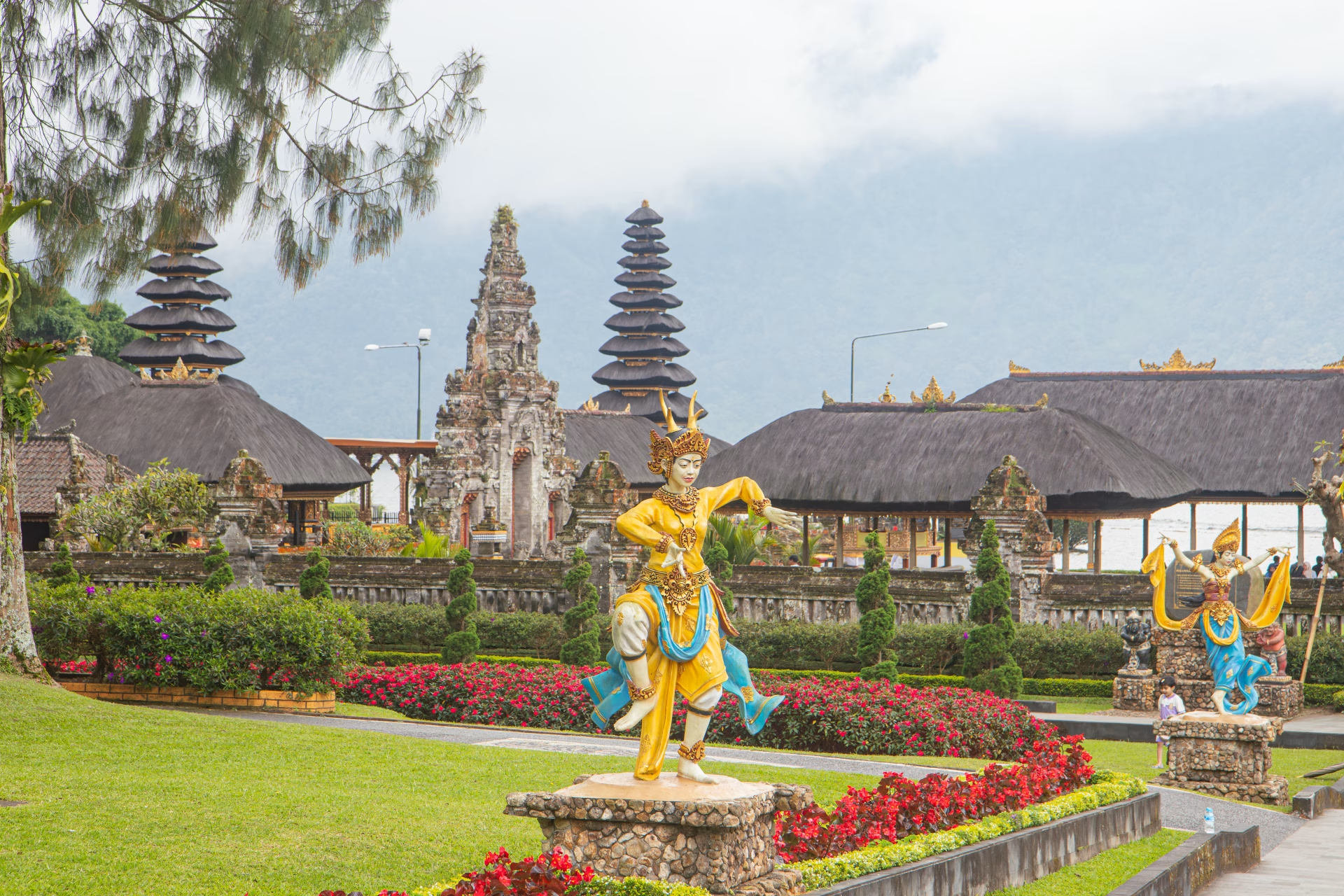
We then head off to visit one of the most beautiful Hindu temples in Bali: Pura Ulun Danu Bratan. This Hindu temple was built in the 17th century, during the reign of King Mengwi. It is dedicated to the Hindu trinity (Brahma, Vishnu and Shiva) as well as to the goddess of water, lakes and rivers, Dewi Danu.


The temple is built on the edge of Lake Bratan. According to legend, the people of the region once lived in great prosperity, surrounded by fertile volcanic land that produced rice in abundance. The soil was so rich that the rice fields yielded crops endlessly. By the time they harvested the rice from one end of the field to the other, it had already grown back on the other side, and it was time to start harvesting again! Over and over. Tired of constantly harvesting rice, the villagers began to complain about this abundance. So, to punish them for their ingratitude, the Gods flooded the fields and rice paddies, creating Lake Bratan. Today, it remains one of Bali’s main water sources.


We spend a long time wandering through the temple’s flower-filled gardens, admiring the traditional Balinese architecture. The main temple, iconic in Bali, seems to float on the water. Even though low clouds obscure the view of the surrounding mountains, it’s one of the most photogenic temples on the island. The main eleven-tiered structure represents the divisions of the sky, according to Hindu beliefs.


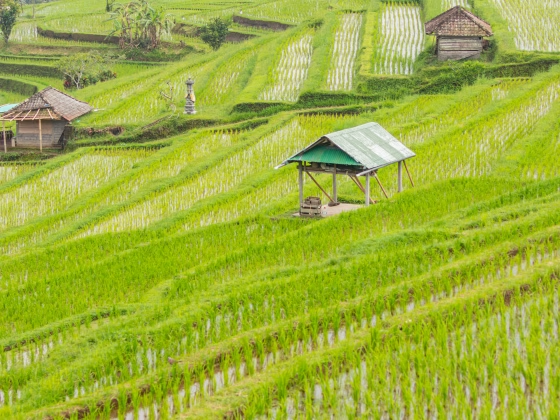
We then continue our journey toward Lovina Beach. The road winds through villages, rice fields, crops, and coffee plantations. There’s traffic everywhere, and it feels chaotic, but our driver skillfully navigates despite our large van. Gradually, we leave the island’s mountainous center. And, around a bend, the vast ocean appears in the distance. The road slopes gently down and we reach the coast.
We finally arrive at our hotel in Lovina Beach, the Ramboutan Hotel, under a torrential downpour. It’s absolutely pouring. We rush to our rooms, bent over under the rain, feet splashing through puddles. Then, already soaked, we decide we might as well go for a swim! We cross the gardens barefoot in swimsuits, with water up to our ankles, and jump straight into the pool, which feels warm compared to the rain. Pure bliss! We stay there, splashing in the rain and chatting, while the downpour rages and thunder rolls.


After a good hot shower, we meet at a warung to enjoy a local meal. On the menu: vegetable soup, vegetable curry, fried rice, stir-fried noodles, chicken skewers, and fresh fruit juice.


Then we head to bed, as we need to get up early tomorrow. Tomorrow, February 6th, is Mom’s birthday, and we’ve planned a surprise she won’t forget anytime soon.