
After visiting Bali’s iconic Hindu temples, then swimming with dolphins at Lovina Beach in northern Bali, we continue our family journey with a visit to central Bali. Far from the beaches, the inland area is mountainous, cool, and lush, with countless things to discover. On the itinerary for these 2 days in central Bali: canyoning at the Aling-Aling waterfalls, visiting a Buddhist monastery, tasting tea and coffee on a plantation, not forgetting the famous Jatiluwih terraced rice fields and our arrival in Ubud, the cultural heart of Bali. A journey full of discoveries… and twists and turns!
Central Bali tour: 2-day itinerary between nature and rice terraces
Saturday, February 7, 2026
This morning, we leave Lovina Beach and its dolphins to explore central Bali on a 2-day itinerary. The inland area is particularly mountainous, with cooler temperatures and many waterfalls. Our driver for the next two days is named Agus. He picks us up at the hotel in his sedan. The car is spacious, but one of us still has to “take one for the team” and squeeze into the trunk. We then leave Bali’s north coast behind and head into the mountains. We take the same road we came in on—after all, there’s only one!
Aling-Aling Waterfalls in Central Bali: Swimming and Canyoning
After 30 minutes on a winding road from Lovina Beach, Agus drops us off at our first stop of the day: the Aling-Aling waterfalls. There are three ways to visit the Aling-Aling waterfalls: a long route, a medium route, and a short route. We hesitate a bit, but finally settle on a balanced option between effort and fun. We are assigned Madi, a mandatory guide, and off we go through the jungle toward the waterfalls.


This first waterfall is very beautiful, nestled in its green setting. It is the tallest of them all. Then we follow the river to reach the other waterfalls a bit upstream. Along the way, we notice sensors installed in the river. They measure rising water levels. When the water reaches their level, alarms are triggered in the villages downstream. But today, everything is calm. Well, calm is an understatement. The waterfalls roar fiercely.
5-meter jump at Aling-Aling Waterfalls
A first 5-meter-high jump platform allows you to dive into the pool below. The boys jump without hesitation.


Natural waterslide at Aling-Aling Waterfalls
But what they are really interested in is the waterfall that flows into the pool. According to Madi, you can climb to the top and slide down it like a natural waterslide. It sounds relatively dangerous, his story. But he is super enthusiastic and assures us it is safe. Lucas agrees to follow him. They cross the river, climb a staircase carved into the rock, and there they are at the top of the waterfall. Lucas sits down, crosses his arms over his chest, and with a small push, he slides down the waterfall and lands heavily in the pool, disappearing for a few seconds before resurfacing a few meters away. Wow! Intense! Delighted, Lucas goes again. And this time, Rémi follows him.
Thrilling jumps from 9 and 14 meters
The Aling-Aling waterfalls are not done offering some thrills to the boys. Along the river, several waterfalls follow one another, of varying heights. They skip the small 2-meter jump to go straight to the 9-meter jump…
Then the 14-meter jump!
Aling-Aling Waterfalls for beginners and the faint-hearted
So brave! And to think that mom and I are shaking at the idea of a 2-meter jump! After a bit of hesitation, I jump. But for mom, since Lucas isn’t here this time to give her a little push (that’s how she ended up jumping 2 meters into a cenote in Mexico 😂), she decides to skip it. She does give the small natural slide a try, though—not without a bit of fear!
Sacred bathing at Bali’s Holy Hot Springs
After all these thrills at the Aling-Aling waterfalls, we head to the Holy Hot Springs for some relaxation. To get there, we have to walk through a long alley of shops. Everyone is selling the same thing: sarongs, dresses, clothes, bags. We get called out from all sides. At the end of the alley, the hot springs are nestled in lush vegetation. There are several pools of naturally warm water. Some are forbidden to tourists because they are reserved for prayer. Yarana and Lucas prefer to sit this one out. Lucas is also starting to feel unwell. We all agree: it’s the Greek salad eaten the day before! Everyone could tell something was suspucious with that waterlogged salad 😅. We laugh, but hope he’ll be okay. Rémi, mom, and I go to relax in the warm water and under the massaging jets.


Meditative visit to Bali’s largest Buddhist monastery
After one hour, we find Lucas sprawled on one of the restaurant tables, completely drained. Back in the car, he finally agrees to take a pill—that’s when you know he’s really not feeling well! We hit the road again to visit another beautiful site in central Bali, while asking Agus to drive slowly. Lucas even sits by the door, just in case. We then go to visit the Brahmavihara-Arama Buddhist monastery, where we are welcomed by a giant statue of Buddha. It is a unique Buddhist temple in Bali, where 87% of the population practices Hinduism. Built in the 1970s, it’s the largest Buddhist temple on the island and stands as a symbol of religious and cultural coexistence.


The place is quiet and almost deserted as we wander through the gardens. There’s a beautiful sense of serenity and spirituality in the air. Everything is well maintained, lush, and carefully maintained. You almost feel like meditating. On top of that, it’s really photogenic. The unique architecture blends Balinese and Buddhist elements in a harmonious way.


We find many Stupas, bell-shaped sculptures. They remind us of the Borobudur temple in Java, which we visited during our first trip to Indonesia in August 2017.


Adventures on Bali’s roads
While we marvel at the beauty of the garden and the Balinese Buddhist temple, Lucas is—let’s not be afraid to say it—on the verge of collapse. He wanders through the gardens, from bench to bench, looking miserable, far from the peaceful, meditative state the place is meant to inspire. We just hope he doesn’t throw up all over a bed of pretty purple flowers! 😂
On the road, his condition doesn’t improve. The road is winding, chaotic, and narrow. Agus weaves through the mountains of central Bali toward Munduk. Then, around a bend, Lucas asks Agus to stop. With surprising quickness, Agus immediatly pulls over to the side just in time for Lucas to open the door, lean out, and throw up. Agus joins him, tissues and a bottle of water in hand, very attentive. He must be used to motion-sick tourists by now (though probably because of his driving, not because of a Greek salad). While Lucas is throwing up his guts, mom exclaims: “Go further, Lucas.” She’s worried she might get sick too.
After a few moments, however, she seems to realize the situation. “Poor thing.” “Are you okay?” “We should have gotten out too to support him.” True enough! Only Agus got out of the car, while the rest of us stayed inside. Mom even told Lucas to go throw up further away. That’s all it takes for us to burst into uncontrollable laughter 🤣. Once he’s pulled himself together, Lucas gets back into the car. He’s feeling better, and we can calmly resume the drive to Munduk. “I tried to do it gracefully,” he says, which only makes us laugh even more.

Night in Munduk in the mountains of central Bali
We then decide to head to our hotel in Munduk so Lucas and Yarana can rest. Munduk is an essential stop when visiting central Bali. Located in the mountains, it offers a cooler climate, especially welcome after the recent heat. Munduk is also known for heavy rainfall, especially during the rainy season! So we are not surprised to arrive at the hotel under a light tropical rain.
Our hotel, nestled in nature, is a real favorite: a resort with breathtaking views over the valley. Traveling in the low season has its advantages, iespecially the chance to stay in Munduk hotels that are usually out of reach, at more affordable prices. Lucas and Yarana immediately go to rest in their room. Rémi, mom, and I sit in the restaurant to try waffles, pancakes, and fried bananas. The restaurant overlooks the valley and, despite the clouds and rain, the view is magnificent.


We also have the same view from our rooms. The balcony opens directly onto the surrounding mountains. And the room itself is also beautiful.


Our hotel in Munduk: an incredible infinity pool overlooking the valley
But the highlight of this hotel is without a doubt its infinity pool. To get there, you have to walk down the endless stairs to the bottom of the hotel, which are particularly slippery. You go down through the soaked gardens under a light rain. And at the bottom, the pool, magnificent facing the view.


At that point, there is only one desire: to jump in and swim! The problem is that it is cold and raining. We hesitate a bit, but ultimately, the opportunity to swim in such a pool in Munduk won’t come around again anytime soon. No sooner said than done, we put our swimsuits back on. Mom goes first. The water is cold, and so is the rain. She goes down one step while shivering. Then two steps, and we can tell she is going to take forever to get in. Then th… But on the third step, there is no step anymore! Mom suddenly disappears into the water with a shriek. Rémi and I burst out laughing 🤣🤣. She resurfaces a few seconds later, stunned and shocked, hair in her face and out of breath. We are in stitches. It takes us a long time to recover from this episode.


Completely frozen, we carefully make our way back up to our rooms, trying not to slip on the uneven, wet stone steps. A hot shower, a bit of rest, and we meet again in the evening at the restaurant to end our first day in central Bali over a good meal. Lucas shows up, slightly recovered. He has just slept 4 hours! However, there is no way he can touch the food, his stomach is still a bit unsettled. It will be vegetable soup for me, chicken skewers (satay ayam) for Rémi, and spaghetti for mom.
Day 2 of our itinerary in central Bali: panoramic view over Twin Lake
Sunday, February 08
After a hearty breakfast, we head back out with Agus to continue our visit of central Bali. The road takes us high into the mountains, where we find ourselves in thick, impenetrable fog. But when we arrive at the Twin Lake viewpoint, a break in the clouds allows us to take a few photos of the view over the mountains of Bali.


Bali Handara Gate: the famous Balinese gates
A long traffic jam then slows us down. Eventually, after an hour, we realize that this endless traffic jam was actually caused by tree trimming along the roadside! Agus then drops us off at Bali Handara Gate. When we came here in 2017, the place was empty and free. Today, you have to park in a small lot, check in at the booth, and pay 50,000 IDR per person as an entrance fee, about €2.50. All that just to take a few photos in front of these beautiful Balinese gates. They have become an essential stop during a visit to central Bali, made famous by social media. We take turns posing in front of the gates until the guard at the entrance comes out with his megaphone and shouts “Next!”, signaling that we must give way to others.


Coffee plantation in Bali: tasting and discovery of Luwak coffee
Next, we head to Hidden Garden. A very brisk guide takes us in charge. She talks extremely fast at the front of our small group of five, then moves on determinedly, leaving us to relay the information like a game of telephone. “What did she say?” “What is this?” We walk through the gardens, where all kinds of plants, herbs, and unimaginable fruits grow: mangosteen, durian, avocado, coconut, papaya, vanilla, turmeric, ginseng, cocoa, and of course coffee.


Luwak Coffee production process
She introduces us to the production process of Luwak Coffee. The luwak is a small furry animal that feeds on coffee cherries in the plantations. It eats the pulp, swallows the bean, digests it, and then excretes it 💩. The droppings are then collected, cleaned to extract the coffee beans, which are roasted and ground. And that’s how one of the most expensive coffees in the world is made!


Tasting Balinese tea and coffee
After visiting the gardens, it’s time for tasting: mangosteen tea, lemongrass, ginger, ginseng, turmeric and red rice, then coffee with vanilla, chocolate, coconut, avocado, ginseng, ginger and of course traditional Balinese coffee. But not the luwak coffee, which is paid separately! We choose not to taste it, as many ethical issues surround luwak coffee, like any economy based on animal exploitation. Indeed, nowadays luwaks are often kept in captivity and mistreated, living in cages and being fed exclusively coffee cherries.

Jatiluwih Rice Terraces: the most beautiful terraced rice fields in Bali
For long minutes, we play along with the tasting experience. We even become food critics! This one is too sweet, that one too bitter, this one too strong, that one too spicy. We even do blind tastings to see if we can recognize each type (we can’t). Finally, back at the shop, we end up buying a few tea/coffee/vanilla pod souvenirs. And under a rainstorm worthy of the best of Bali’s rainy season, we head back to the car. Next stop in our visit of central Bali: one of the island’s most famous gems, the Jatiluwih rice terraces!


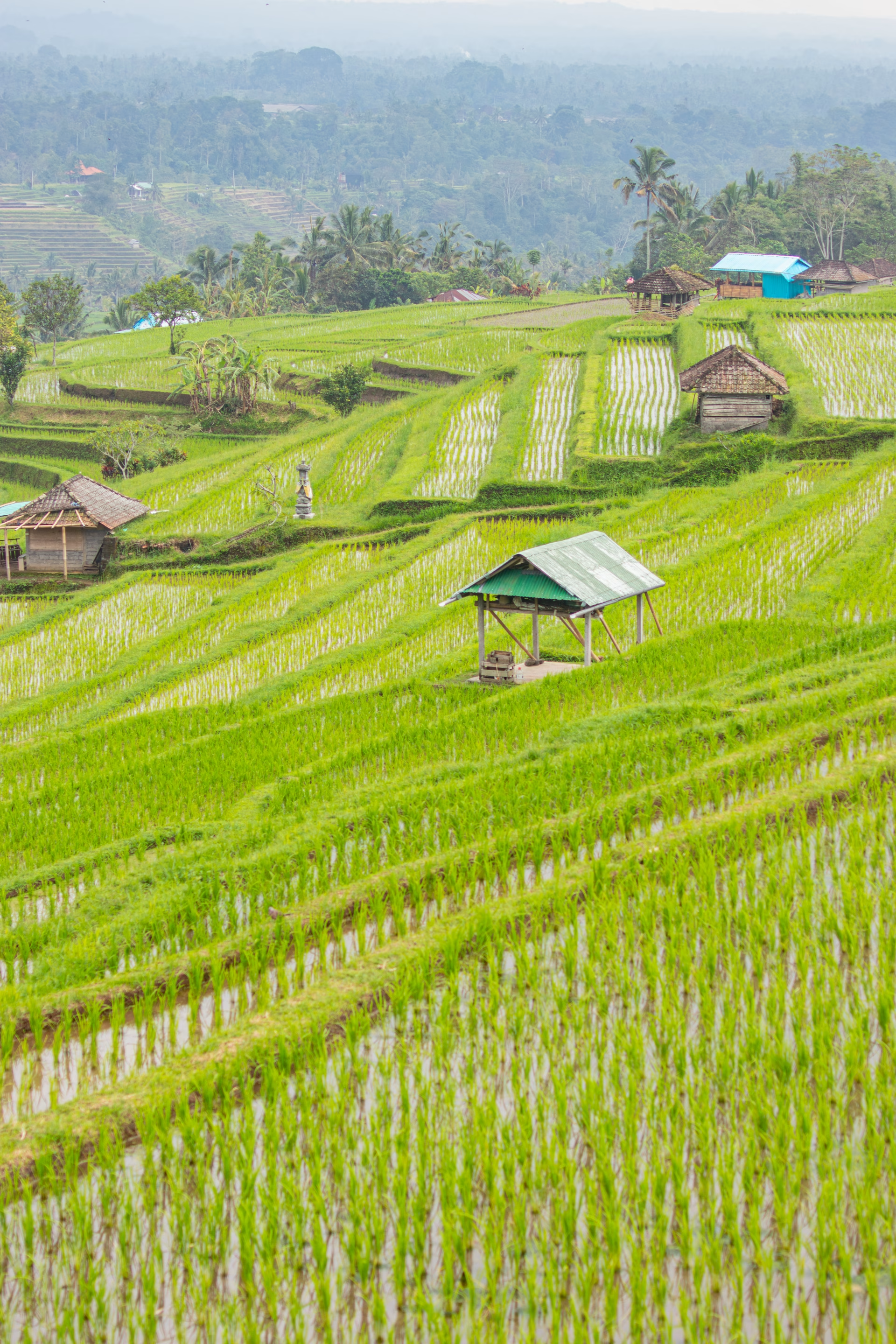
Jatiluwih rice terraces are listed as a UNESCO World Heritage Site. The half-hour drive lets us leave the rain behind, and under a grey but clear sky, we discover the incredible terraced rice fields so typical of Bali. The landscape is stunning, with vibrant green tones and volcanoes in the background. Incredible!


Hiking in the heart of the Jatiluwih rice terraces
A small hiking trail takes us into the heart of the rice fields. How beautiful! The plantations are still young, but they have grown enough to cover the landscape in a beautiful green. We love this color!


Ubud: next must-see stop on our Bali trip
After this magnificent walk through the Jatiluwih rice terraces, we settle in a restaurant offering a breathtaking view over the fields. However, the food is a disaster. That’s the risk with very touristy restaurants. No matter: we’ll make up for it tonight. Our visit of central Bali is far from over. We now hit the road toward the next stop on our itinerary in Bali, which we are really looking forward to: Ubud, the true cultural heart of Bali, known for its artistic atmosphere, temples, and lively local life. A new side of the island awaits us.

![[Indonésie] Sumatra – Cap au Nord à Pulau Weh](https://i0.wp.com/live.staticflickr.com/65535/51158407006_c833dac727_k.jpg?resize=560%2C420&ssl=1)