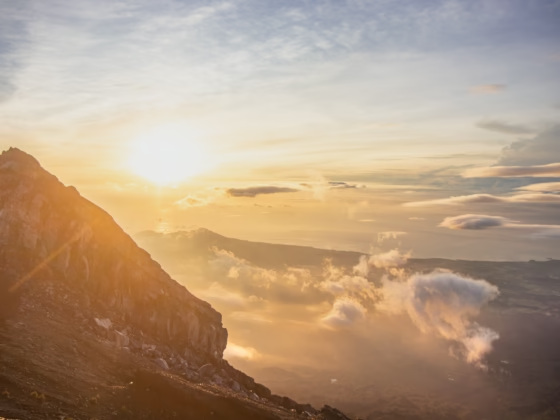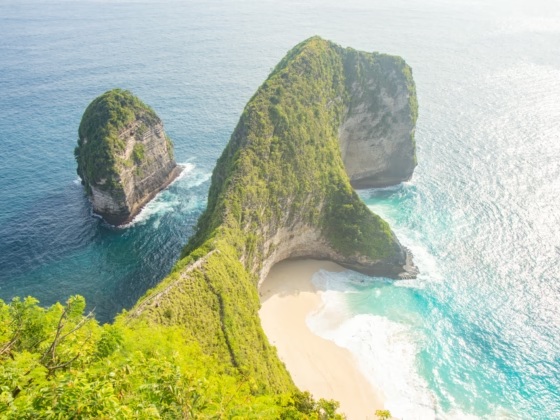
Goodbye, Bali! At least for now 😉. After discovering North Bali’s coastline and its dolphins, then spending five adventure-filled days in Ubud and its surroundings, it’s time for us to leave Bali. For the next three epic days, we’re heading out on an adventure to Java, Bali’s neighbouring island. The plan for our three-day Java road trip: climbing Kawah Ijen, one of Indonesia’s most famous volcanoes. On a nighttime hike, we’re setting out to discover this active Indonesian volcano, famous for its blue flames, sulfur mine, and spectacular turquoise acid lake. We love volcanoes, so we’re in for a treat!
Off to Java: Heading for the Kawah Ijen Climb
Java is the large island just west of Bali, home to Indonesia’s former capital, Jakarta. Far less touristy than its famous neighbour, East Java is home to some of Indonesia’s most impressive volcanoes, including Kawah Ijen and Mount Bromo.
Friday, February 13, 2026
Still amazed by our climb to Bali’s highest volcano, Mount Agung, we set off for Java. To visit the two famous volcanoes of East Java, Ijen and Bromo, we’ve booked an all-inclusive tour from Ubud. Visiting both Ijen and Bromo from Bali means covering a lot of ground in just three days. We have a long journey ahead of us. Our driver, Radin, picks us up from our hotel in Ubud at noon. We also pick up his co-pilot, who will supposedly help him through the long hours on the road (not at all, as it turns out, she’s actually his girlfriend, and he’s treating her to an all-expenses-paid weekend). Then we leave Ubud and its chaotic traffic behind. Five hours of driving along the coast take us to Gilimanuk Harbour, on the western tip of Bali. From there, a peaceful one-hour ferry crossing takes us to Java.


We then set off on a long drive towards Kawah Ijen. Since we’re going to spend 24 hours in the car with Radin (yes, 24 hours of driving in total!), I’ll take a few lines to introduce the character. Radin is a skilled driver, but impatient, even hot-tempered. If it weren’t for Indonesia’s chaotic traffic, he would probably drive far too fast. In fact, the traffic doesn’t stop him from putting his foot down whenever he gets the chance, regardless of scooters, pedestrians, animals, or children on the road.
The only thing that can stop him is a vehicle bigger than his. When that happens, he gets as close as possible without actually touching it, edges slightly to the right to see what’s coming in the opposite lane, and then waits for his moment. And his moment rarely comes at the same time as ours! Most of the time, we all think, “No way, that’s not going to fit.” But believe me, in Indonesia, with Radin behind the wheel, it always fits. Sometimes just barely. Sometimes really barely. Long story short: we thought we were going to die about ten times. Seriously. And our adventures with him are far from over…
Our Accommodation Near Kawah Ijen: A Basic but Decent Homestay
Finally, we arrive at 8 p.m., after nine hours on the road and a time zone change. We’re on edge, exhausted, and desperately need some peace and quiet, far away from the road and our driver’s frantic driving. He drops us off at a homestay, a small, budget guesthouse run by locals. The place is basic but clean, and it will do just fine for the night. At the restaurant, we’re served pisang goreng (fried bananas), mie goreng (fried noodles), and some wonderfully fragrant jasmine tea. Just what we need to unwind a little. Then we head to bed, exhausted after such a chaotic day on the road.


Nighttime Hike up Kawah Ijen: A Challenging Trek Through Toxic Fumes
Saturday, February 14
Radin picks us up from the hotel at 1 a.m. We take a narrow winding road through the mountains to reach the starting point of the Kawah Ijen volcano hike. There, we find a few dozen other tourists, mostly Indonesians. While waiting for Kawah Ijen National Park to open, we enjoy some fried bananas to fuel up for the challenging hike ahead. We had heard about a mandatory medical check-up before visiting Kawah Ijen. But perhaps because we’re travelling during the low season, nobody mentions it. At 2 a.m., accompanied by our young guide, Ali, we set off up the volcano’s slopes. The hike to the crater is 3 kilometres long, with 500 metres of elevation gain.
As we approach the summit, a gust of wind suddenly blows the smell of sulfur towards us. We immediately start coughing, our eyes watering. The air becomes impossible to breathe, and it’s quite frightening. Ali quickly signals for us to put on our gas masks. Kawah Ijen releases toxic sulfur fumes, so carrying a gas mask is mandatory. Without hesitation, we put our masks on and continue hiking.


Walking with this enormous mask covering our faces is no easy task. Whenever the wind shifts and the air becomes breathable again, we take them off. After two hours of hiking, we reach the volcano’s rim. The inside of the crater is pitch-black, but we can clearly make out a procession of lights making their way down into its depths. It’s quite a sight. Kawah Ijen is an active volcano, and we can clearly see the white plumes of smoke rising from the crater. The thought of going down there, surrounded by all those people, is rather unsettling.


Down into the Crater in Search of Kawah Ijen’s Famous Blue Flames
The descent into the Ijen crater is challenging. The terrain is rough, with steep steps and sections of trail running along dizzying drops. We keep putting our masks on and taking them off as the wind blows sulfur fumes in our direction. They sting our eyes, noses, and throats, and sometimes we even find ourselves coughing through the masks. We have to stay calm, avoid panicking, and wait for the fumes to pass. Eventually, we reach the bottom of the crater and make our way towards the sulfur mine. Kawah Ijen is famous for its spectacular “blue flames”. This rare phenomenon is caused by sulfur igniting when it comes into contact with oxygen at extremely high temperatures. The flames can only be seen at night, which is why we set off so early. Unfortunately, recent rainfall means the phenomenon isn’t happening today. What a shame!


Kawah Ijen’s Sulfur Miners: Dangerous and Backbreaking Work
Here, beneath a cloud of smoke, sulfur miners work, sometimes without masks or protective equipment. Using pickaxes and shovels, they break chunks of sulfur loose from the mountain. It’s exhausting and dangerous work, carried out among dozens of tourists. We try not to get in their way, although they are often happy to pose for photos or sell small sulfur figurines. They can carry up to 90 kilos of sulfur in two bamboo baskets slung over their shoulders as they climb back up to the volcano’s rim.
Sulfur miners earn around 1,000 Indonesian rupiahs per kilo of sulfur, or roughly €0.05. By making two round trips a day on average, they earn more than many agricultural workers in the region. Even so, their working conditions remain extremely harsh: they work amid toxic fumes and carry very heavy loads up steep slopes. Many suffer from respiratory or joint problems, and some eventually move into tourism, becoming guides for visitors to Kawah Ijen.
Daylight gradually creeps in, bathing the crater in a grey glow. We can now see the mine more clearly, along with the gaping holes in the rock that continuously release clouds of smoke. As the sun rises, the atmosphere becomes less oppressive. We even feel as though we can breathe more easily. In reality, we’ve simply learned to anticipate changes in the wind direction, and therefore the movement of the fumes. As soon as the wind shifts, we quickly put our masks back on and wait for it to pass. Once it does, we can take them off again.


Peaceful but Dangerous: The Volcano’s Acid Lake
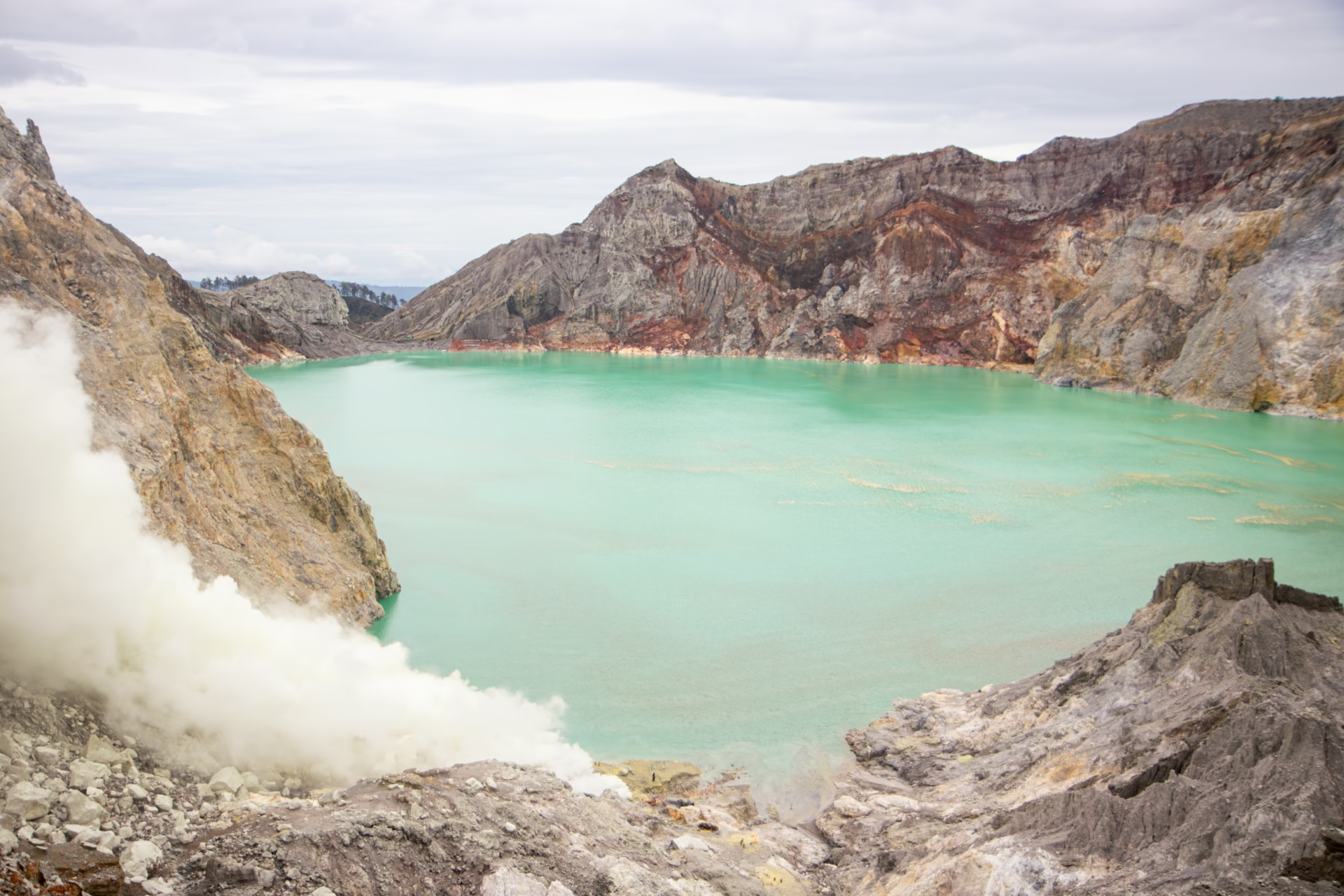
Kawah Ijen is home to an impressive turquoise volcanic lake, considered the most acidic lake in the world, with a pH close to 0. This extreme acidity is caused by sulfur gases released by the volcano, which dissolve in the water and form highly corrosive acids.


The Otherworldly Landscapes of Kawah Ijen Volcano
After spending two hours at the bottom of the crater, taking in its apocalyptic atmosphere, it’s time to climb back up. We take one last look at the almost unreal scene. The sight at Kawah Ijen is both awe-inspiring and heartbreaking. As we gain altitude, the entire crater gradually comes into view, sometimes shrouded in thick clouds of smoke…


And sometimes completely clear, when a gust of wind sweeps the smoke away.

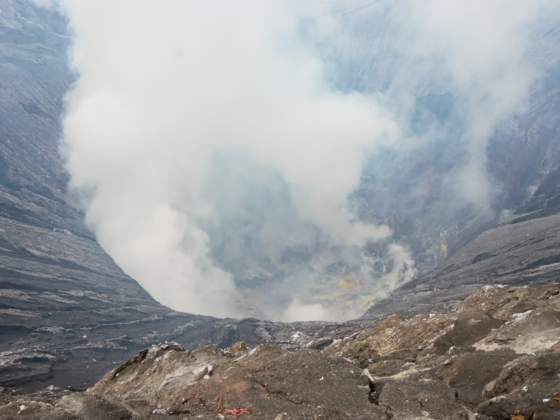
As we climb higher along the crater’s rugged slopes, the full beauty of the landscape unfolds before our amazed eyes. That’s the magic of nighttime volcano hikes: it’s only at daybreak that you discover what the darkness has been hiding. We can finally see the immense crater of Kawah Ijen, with its steep, sheer rock walls. And nestled at its bottom, the volcanic lake shimmers in shades of blue and green, both peaceful and dangerous, almost hypnotic. It’s absolutely breathtaking.


Our Kawah Ijen Climb: Final Thoughts
We finally reach the volcano’s rim after a long climb. We have little hope of catching the sunrise today, but it doesn’t matter. The view of the volcano is perfectly clear, and that’s all we could have hoped for on our Kawah Ijen hike during the rainy season. We realise just how lucky we are as we take one last look at the volcano’s smoking crater. We’re a little sad to leave it behind. Although we didn’t get to see the famous blue flames, that disappointment is nothing compared to the incredible experience Ijen has given us.

The descent down the volcano’s slopes is long and exhausting. The trail is steep, and even though the path is smooth and even, it’s tough on the knees. It’s not until 9 a.m., after two hours of downhill hiking, that we finally reach the starting point of the Ijen trail. Climbing Kawah Ijen on the island of Java in Indonesia is not particularly strenuous, although the descent into the crater (and the climb back out) is quite rugged and sometimes dizzying. However, the toxic fumes and the nighttime descent into the volcano’s crater can be overwhelming and frightening. You also need to be careful not to get in the way of the sulfur miners, who continue their difficult work amid the crowds of tourists.
We treat ourselves to a hearty breakfast at the only warung at the foot of Ijen, then Radin urges us to get back on the road. After all, we still have eight hours of driving ahead of us to reach another famous volcano in Java: Mount Bromo.
Practical Information for Climbing Kawah Ijen
Is the Kawah Ijen Hike Difficult?
The climb up Ijen is not considered technical and has no major difficulties, apart from a steep, continuous ascent over 3 kilometres. That said, you should still come prepared. Good hiking shoes are essential. Trekking poles can also be useful, as the trail is steep on the volcano’s slopes and rough inside the crater. You’ll also need a headlamp, which our guide provided, as the hike takes place at night.
Do You Need a Medical Certificate Before Climbing Ijen?
Since 2024, a medical fitness certificate (issued less than 48 hours before the visit) has apparently been mandatory for visiting Kawah Ijen. This is intended to ensure that hikers tackling the volcano’s slopes are physically fit enough for the climb. In practice, however, nobody mentioned it or asked us to provide one, perhaps because we were there in February, during the low season.
Can You Climb Kawah Ijen During the Rainy Season?
Yes! Of course, the chances of bad weather and difficult conditions (rain, cold, mud, and slippery trails) are higher during the rainy season than at other times of the year. But climbing Mount Ijen during the rainy season is perfectly possible. One advantage is that there are far fewer people around at this time of year. That means less jostling for space at the bottom of the crater.
Is Kawah Ijen Dangerous?
Ijen is an active volcano, so there is always some risk involved. However, in practice, climbing Ijen and descending into its crater are relatively safe activities, especially when accompanied by a guide. The main risk comes from the toxic sulfur fumes released by the volcano. That’s why wearing a gas mask is mandatory when climbing Ijen. Your guide will provide one.
Can You See the Blue Flames All Year Round?
Yes, Kawah Ijen’s famous blue flames can be seen all year round, as they are caused by the combustion of sulfur gases released by the volcano. They are only visible at night. However, heavy recent rainfall can cool down or disrupt the flows of burning sulfur, making the phenomenon much less visible or even causing it to disappear altogether. That’s exactly what happened during our hike, despite setting off in the middle of the night in the hope of seeing them.