
We continue our discovery of Ubud and its surroundings. It has already been 4 days since we arrived in Ubud. Between city strolls and rice harvesting in the rice fields and dance performances and local markets, we are discovering all the facets of this cultural and spiritual city. Today, our driver Bob takes us to explore the surroundings of Ubud during a day rich in spirituality, culture, and must-see visits in Bali. So, what to do around Ubud? We’ll take you along!
The terraced rice fields of Tegallalang
Our day of visiting around Ubud begins with a visit to the terraced rice fields of Tegallalang. Less known than the terraced rice fields of Jatiluwih, these rice fields are located in a narrow valley. It is one of the places that has changed the most since our last visit nine years ago. At that time, we freely wandered through the rice fields, paying a symbolic passage fee to the farmers who worked the fields. Now, the construction of a large complex blocks the entrance to the rice fields. We now have to pay entrance fees, which go directly into the pockets of the owners, and no longer to the farmers.
The viewpoints overlooking the valley are “instagrammable” spots: swings, zip lines, hearts, lovers’ nests. An infinity pool is even under construction. The place has lost much of its charm and authenticity. Moreover, the area of the rice fields has greatly decreased in favor of hotels and restaurants.


The Hindu temple of Tirta Empul: the temple of sacred waters
The sacred temple of Tirta Empul is located about fifteen kilometers north of Ubud. “Tirta Empul” means “source of sacred water” in Balinese. It is dedicated to Vishnu, the Hindu god of water. Balinese people come to pray and purify themselves in the sacred water springs that feed the purification pools. It is a purification and healing ritual that is said to eliminate diseases and bad karma. The ritual begins with an offering presented to the god. Thus, dozens of colorful floral offerings dot the altar at the entrance of the temple. They fill the air with the intoxicating scents of Balinese incense. The large purification pool consists of 13 fountains. Balinese people purify themselves and pray in front of each of them from left to right, possibly skipping fountains 11 and 12, as they are reserved for rituals related to the dead.


The viewpoint of Mount Batur, an active volcano in Bali
Our visit to the must-see sites of Bali around Ubud then takes us to the viewpoint of Mount Batur, one of Bali’s active volcanoes. We climbed it the day before (article coming soon!), and we are happy to admire its massive shape and volcanic lake from another viewpoint. The crater is clearly visible, covered in vegetation. Mount Batur rises to 1717 meters above sea level, and its last eruption was in the year 2000.

Besakih temple, the largest temple in Bali
Besakih temple is also known as the mother temple of Bali. Located on the slopes of Mount Agung, the highest volcano on the island (which we also climbed, stay tuned!), this Hindu temple is the largest temple in Bali. It is a vast complex of temples. The main temples celebrate the Hindu gods Shiva the destroyer, Brahma the creator, and Vishnu the protector. Besakih temple’s significance comes from a “miracle” that occurred in 1963 when Mount Agung erupted. The temple was not damaged by the eruption, nor by the earthquakes that followed. This seemed impossible due to its proximity to the volcano. During our visit, the clouds obscured Mount Agung, the sacred mountain and resting place of the gods, but we could still see its imposing base.


Hindu religious ceremony at Besakih temple
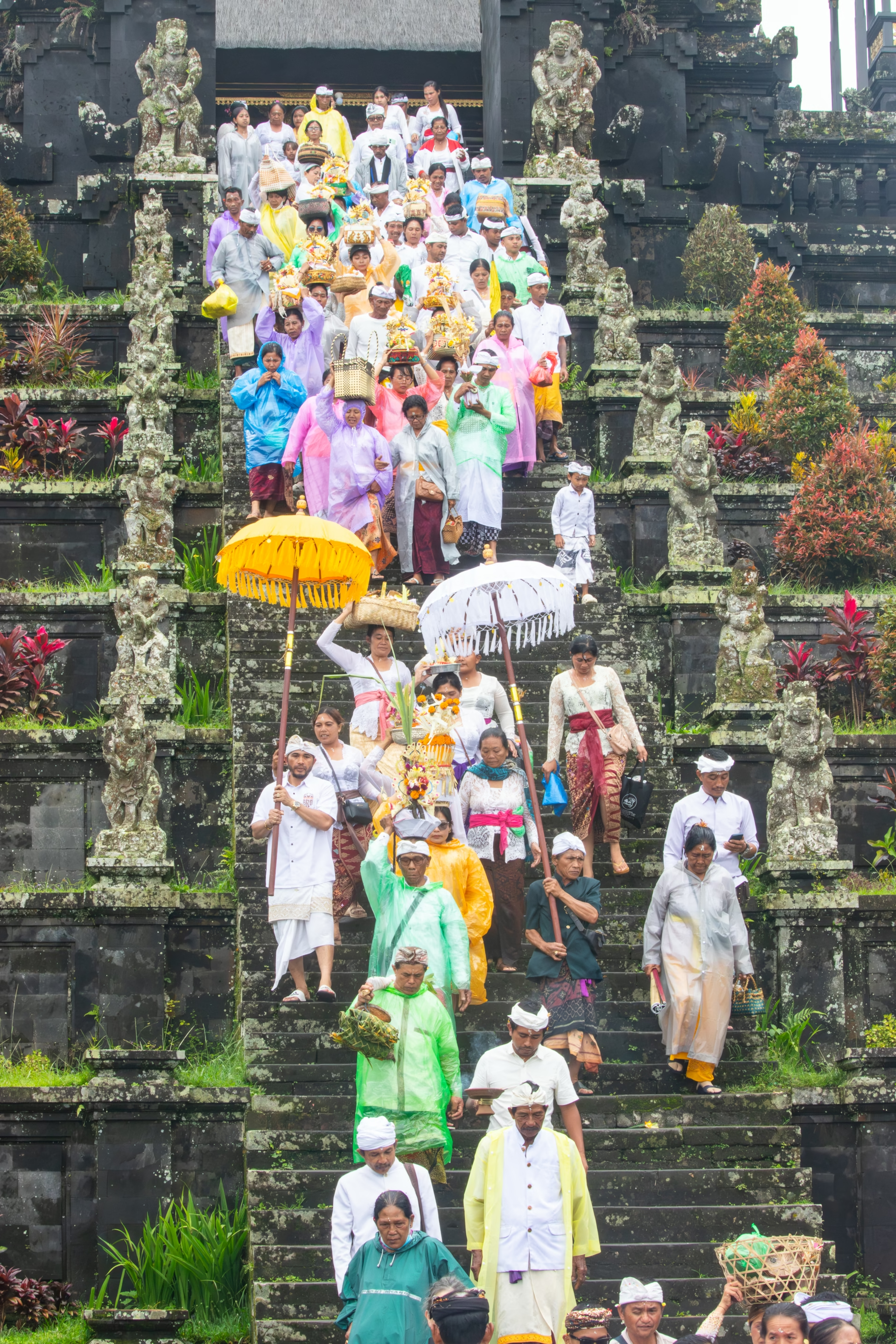
As tourists, we cannot enter the main temple, which is reserved for locals. So we content ourselves with admiring it from the entrance. A ceremony is underway, and dozens of locals are praying and making offerings. Our guide takes the time to explain the ceremony’s proceedings and the significance of the various relics used. The umbrellas have a spiritual protective function. They are traditionally found above altars, statues, or shrines.
The red umbrella is associated with the god Brahma, the creator. It symbolizes creation, power, and protection. The yellow umbrella is associated with the god Vishnu, the protector. It symbolizes prosperity and wisdom. The white umbrella is associated with the god Shiva, the destroyer. It symbolizes purity, connection to the divine, and spiritual protection. Finally, the black and white checkered umbrella symbolizes the duality of good and evil and the balance of forces.


Religious procession at Besakih temple
Besakih temple is a magnificent temple. Discovering it with a guide (now mandatory) allows us to learn more about Balinese culture and Hindu beliefs. At the end of the visit, we leave the temple just as the ceremony concludes. We thus witness a long procession leaving the main temple. Everyone wears traditional attire, with the famous sarong, but also very colorful rain ponchos that brighten the procession with vivid colors. They also have grains of rice stuck to their foreheads. This is a common ritual during Hindu ceremonies. The grains of rice symbolize the blessing of the gods, purity, prosperity, abundance, and spiritual protection.


The Goa Gajah temple, the elephant cave
We then head to visit the Goa Gajah temple, just a few minutes from the center of Ubud. The other name for this temple is the “Elephant Cave.” It is one of the oldest and most mysterious sites in Bali. At the time of its construction in the 11th century, it was a place of spiritual meditation. Its inspirations come from both Hinduism and Buddhism. Its most famous feature is the entrance to the cave: it is a huge mouth sculpted in the rock, representing a demon or a protective spirit. Inside, there are prayer altars where monks would come to meditate, away from the outside world.


We then return to Ubud after a long day visiting the must-see sites around Ubud with our driver Bob. We stop in town to have an ice cream, then head to the hotel. Tonight, Yarana is returning to Denpasar to catch her flight to Hong Kong. So it will be four of us continuing our discovery of Bali… or rather three tomorrow, as mom has declared herself out for the incredible athletic ascent that awaits us: the ascent of Bali’s highest volcano: Mount Agung!

![[Indonésie] Sumatra – Cap au Nord à Pulau Weh](https://i0.wp.com/live.staticflickr.com/65535/51158407006_c833dac727_k.jpg?resize=560%2C420&ssl=1)