Did you know there is a fifth season in Quebec? At the end of winter, during the snowmelt, when the trees slowly awaken from their winter dormancy. This in-between season lasts about six weeks between March and April, marking the end of the Quebec winter. Between the end of winter and the beginning of spring, weather conditions are very specific: they alternate between periods of freezing and thawing. And it is this cycle that allows the sap to rise inside the trees and then flow out. This period is known as the sugaring-off season.

During this period, maple sap, or maple water (yes, that’s what we’re talking about!), is rich in nutrients and water, which gives it a very slight natural sweetness. And maple water is the base used to make the famous maple syrup! The sugaring-off season is a highly symbolic time in Quebec. It has existed for several centuries. In fact, collecting maple sap was already an important activity for Indigenous peoples long before the arrival of the first explorers. The sugaring-off season is therefore a key period in maple syrup production. And maple syrup in Quebec is a whole story in itself. It is an integral part of Quebec’s cultural and culinary identity, and the province accounts for about 70% of global maple syrup production 🍁.
And this year, we added our own small contribution to maple syrup production! We went to Beauce, south of Quebec City, to make our own maple syrup – the traditional way! It was a long and intense process that took us the whole day. So, bright and early (well, almost—our friends’ van had a bit of trouble starting 🤒), we met Marie-Paule and David from L’Apprentie Sucrière at their sugar bush. We were deep in the forest, far from roads and houses, with no electricity, no running water, and no cell service. There were nine of us coming from Montreal, and trust me, we were just enough to take on the challenge of making our own maple syrup!

The day begins in the forest, in the mud and fallen leaves, among the maple trees. We start by “running the maples” to collect the maple sap. We go around the 150 tapped trees on the property to gather their sap. Some trees have produced a lot, others a bit less. And it depends on the type of maple tree.


David has two types of maple trees in his sugar bush: the sugar maple, which produces a lot of sap and yields very sweet sap, and the red maple, which produces less sap and slightly less sweet sap. To make our own maple syrup, we will mix the sap from both types of trees. To collect the sap, David uses a traditional method: each tree is tapped with a single incision, into which a spout is inserted. Then, a bucket is hung from each spout to collect the sap as it slowly flows out. Some of them are quite full!


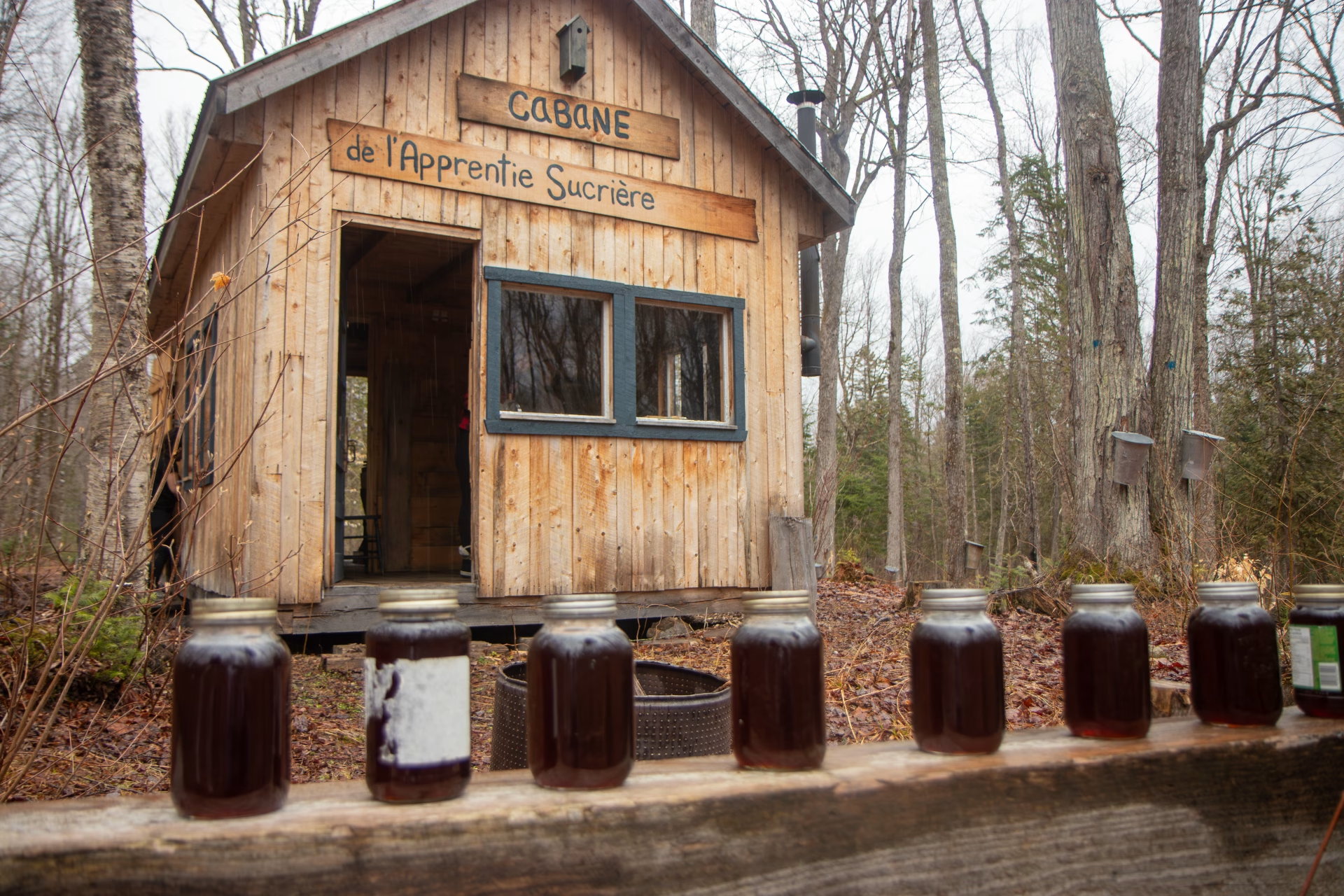
And of course, we eagerly taste the maple water, which is very clear and has a very slightly sweet flavor. It’s a promising start for our syrup! The sugaring-off season is coming to an end, and we are the last group of the season. So we collect every last drop and carry several full buckets back to the L’Apprentie Sucrière sugar shack. This small rustic cabin, built by Marie-Paule and David in the heart of their sugar bush, has no electricity and no running water. But it contains all the tools needed to make maple syrup… the traditional way!


More than 350 liters! That’s the amount of maple sap we collect. But don’t worry, 350 liters of maple sap does not mean 350 liters of maple syrup at the end. Unfortunately 😆! We first pour the freshly collected maple sap into a large elevated tank that filters it, removing all impurities such as fallen leaves and insects.


From there, the maple sap flows directly into the “boiler,” or evaporator, heated over a wood fire, where it is slowly and continuously boiled. It is this slow concentration process that develops the characteristic flavor of maple syrup. The more you heat sugar, the more it caramelizes and develops its aromas. For our part, we have the whole day to heat the maple sap and turn it into syrup. After a few explanations and demonstrations, Marie-Paule steps away and leaves us in charge of the sugar shack. The quality of our future maple syrup is now in our hands!

So we spend the day taking turns chopping wood…


…to feed the evaporator, which consumes a huge amount of wood! It must be kept at a very high temperature so that the boiling never slows down. The heat inside is unbearable. And it needs to be fed roughly every 10 minutes!


It’s a relentless and exhausting cycle! The evaporator is extremely wood-hungry. To feed it every 10 minutes, we constantly have to produce small logs. We had even brought board games to pass the time—yeah right! We spend the whole day chopping wood and feeding the evaporator at a frantic pace. And meanwhile, the maple sap keeps steadily evaporating. The cabin fills with water vapor, and it becomes extremely hot inside. Above all, a sweet aroma spreads through the air—very promising. It’s enough to make our mouths water!


Since there are nine of us, we do have the luxury of rotating through all the tasks. When our syrup starts to thicken, we take a small amount and boil it over a wood stove for several long minutes. From there, we’re able to make our own maple taffy on snow, which is delicious! We pour the hot syrup, now nicely thickened, over the snow, where it hardens on contact with the cold. From there, we can roll it onto a stick to make a lollipop! Then we vigorously whip the remaining syrup to turn it into… maple butter, absolutely delicious on pancakes 😋.


At the end of the day, Marie-Paule reappears. She inspects our maple sap, which has thickened into a rich, syrupy consistency. Our maple syrup is born! Marie-Paule pours the mixture into a new pot fitted with a felt filter. This helps remove any small impurities. Then it’s time for bottling!


As a result, from the 350 liters of maple sap we collected in the morning, we finally end up with nearly 9 liters of maple syrup! 9 liters! A great production! Each of us leaves with a large jar of maple syrup. That’s going to make a lot of pancakes! 😁 We also take home a jar of filtered maple water, which is much lighter in color than the syrup. We tried it during the afternoon, and it works particularly well with a bit of… rum!


Making your own maple syrup the traditional way is a more intense activity than we expected! However, we had a wonderful day and highly recommend coming to experience the rustic adventure with David and Marie-Paule at L’Apprentie Sucrière!